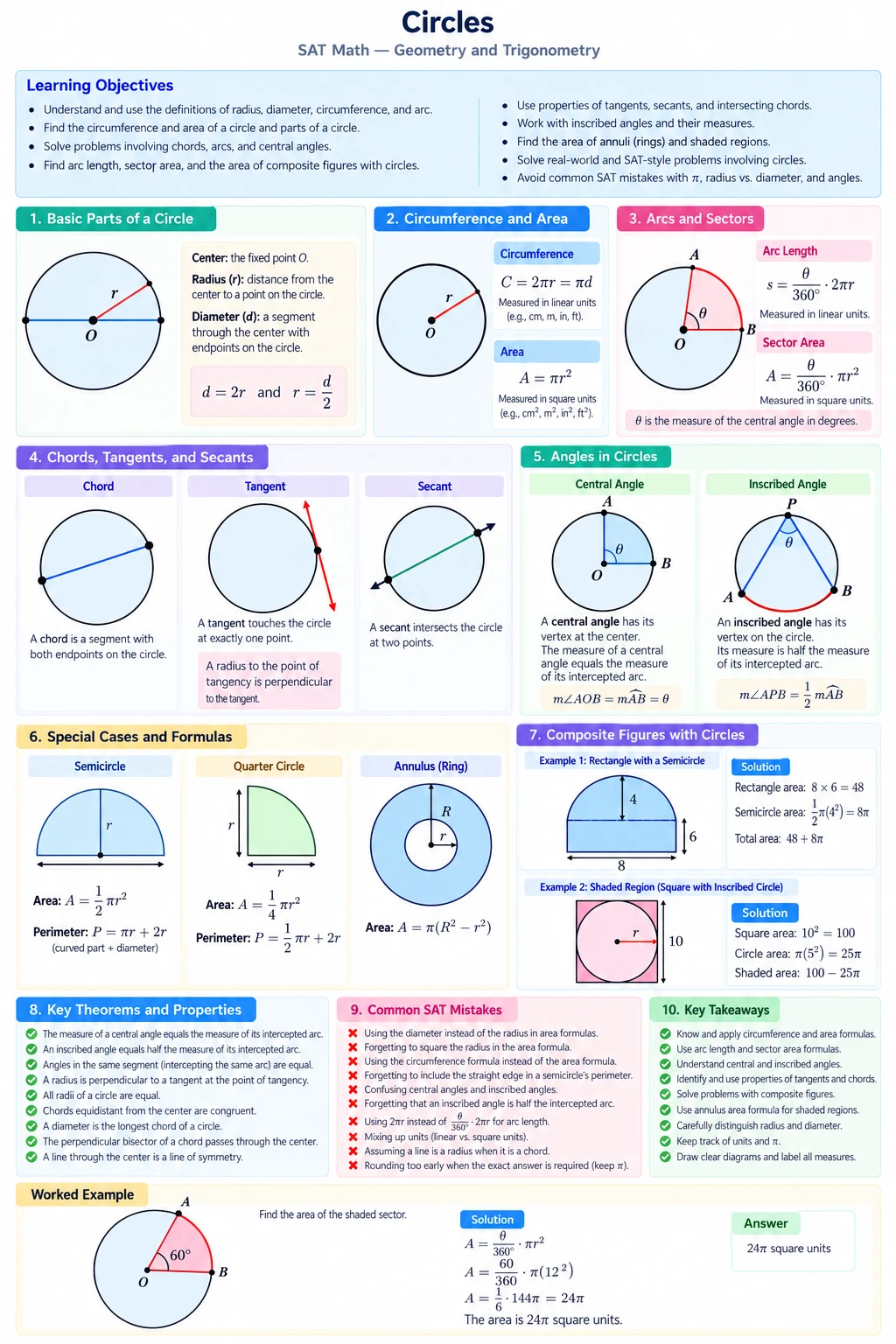
Circles
Learn arc length, sector area, circle equations and angle relationships. Work through tangent, chord and shaded-region problems for SAT Math.
Circles
SAT Math — Geometry and Trigonometry
Learning Objectives
By the end of this lesson, you should be able to:
Identify the radius, diameter, chord, arc, tangent, and secant of a circle.
Calculate circumference and area.
Find arc lengths and sector areas using central angles.
Solve problems involving semicircles, quarter circles, and annuli.
Determine central and inscribed angle measures.
Apply geometric properties of chords and tangent lines.
Use the equation of a circle in the coordinate plane.
Solve problems involving circles and right triangles.
Calculate shaded regions and composite areas.
Apply circle geometry to multistep SAT-style questions.
1. Understanding Circles
A circle is the set of all points in a plane that are the same distance from a fixed point called the center.
The distance from the center to any point on the circle is called the radius.
Important parts of a circle include:
Center: The fixed point at the middle of the circle.
Radius (r): A segment connecting the center to a point on the circle.
Diameter (d): A segment passing through the center with both endpoints on the circle.
Circumference: The distance around the circle.
Chord: A segment connecting two points on the circle.
Arc: A portion of the circumference.
Tangent: A line touching the circle at exactly one point.
Secant: A line intersecting the circle at two points.
Relationship Between Radius and Diameter
d = 2r
r = d/2
Example
A circle has diameter 18 cm.
Radius = 18/2
Radius = 9 cm
SAT Tip: Always determine whether the given measurement is a radius or diameter before selecting a formula.
2. Circumference of a Circle
Circumference is the distance around a circle.
The formula is:
C = 2πr
Alternatively:
C = πd
Here π is a mathematical constant approximately equal to 3.14159.
Worked Example 1
A circle has radius 7 units.
Find its circumference.
Step 1: Use the circumference formula.
C = 2πr
Step 2: Substitute r = 7.
C = 2π(7)
C = 14π units
Worked Example 2
A circle has circumference 24π.
Find its diameter.
C = πd
24π = πd
d = 24
SAT Tip
When a question requests an exact answer, leave the answer in terms of π unless otherwise instructed.
3. Area of a Circle
The area of a circle measures the space enclosed by its circumference.
Formula:
A = πr²
Worked Example
A circle has radius 5 cm.
A = π(5²)
A = 25π cm²
Finding the Radius From the Area
A circle has area 81π square units.
Find its radius.
81π = πr²
81 = r²
r = 9
The radius is positive because it represents a length.
Important SAT Trap
If the diameter is given, divide by 2 before applying the area formula.
For example, if the diameter is 12:
Radius = 6
Area = π(6²)
Area = 36π
Do not calculate 144π using the diameter as the radius.
4. Arcs and Central Angles
A central angle is an angle whose vertex is at the center of a circle.
Its sides are radii.
A central angle divides a circle into arcs.
The measure of a minor arc equals the measure of its central angle.
For example, a central angle of 80° intercepts a minor arc measuring 80°.
A full circle measures 360°.
Therefore, the portion of the circumference represented by an arc is determined by:
Central angle / 360°
5. Arc Length
Arc length is the distance measured along part of the circumference.
Formula:
Arc length = (θ/360°) × 2πr
Where:
θ = central angle in degrees
r = radius
Worked Example
A circle has radius 12 and a central angle of 60°.
Find the length of the minor arc.
Step 1: Write the formula.
Arc length = (60/360) × 2π(12)
Step 2: Simplify.
Arc length = (1/6)(24π)
Arc length = 4π units
Another Example
A circle has radius 9 and a central angle of 120°.
Arc length = (120/360) × 18π
Arc length = (1/3)(18π)
Arc length = 6π units
SAT Tip: Arc length is measured in linear units, not square units.
6. Sector Area
A sector is a region of a circle bounded by two radii and an arc.
The area of a sector is a fraction of the full circle's area.
Formula:
Sector area = (θ/360°) × πr²
Worked Example
A circle has radius 12.
A sector has a central angle of 60°.
Step 1: Find the full circle area.
A = π(12²) = 144π
Step 2: Calculate the sector fraction.
60/360 = 1/6
Step 3: Multiply.
Sector area = (1/6)(144π)
Sector area = 24π square units
Another Example
A circle has radius 10 and a 90° sector.
Sector area = (90/360) × 100π
Sector area = (1/4)(100π)
Sector area = 25π
7. Difference Between Arc Length and Sector Area
Arc length measures the curved boundary of a sector.
Sector area measures the two-dimensional region inside that sector.
Quantity | Formula | Units |
|---|---|---|
Arc length | (θ/360) × 2πr | Linear units |
Sector area | (θ/360) × πr² | Square units |
For example, a 90° sector represents one-fourth of a circle.
Its arc length is one-fourth of the circumference.
Its area is one-fourth of the circle's area.
8. Semicircles and Quarter Circles
A semicircle represents half a circle.
A quarter circle represents one-fourth of a circle.
Semicircle Area
A = ½πr²
Semicircle Perimeter
P = πr + 2r
The perimeter includes the curved arc and the straight diameter.
Quarter-Circle Area
A = ¼πr²
Quarter-Circle Perimeter
P = ½πr + 2r
Worked Example
A semicircle has radius 8.
Area = ½π(8²)
Area = 32π
Curved boundary = π(8) = 8π
Straight boundary = 16
Perimeter = 8π + 16
9. Chords
A chord is a line segment joining two points on a circle.
The diameter is the longest possible chord because it passes through the center.
Important chord properties include:
All radii of the same circle are equal.
Equal chords in the same circle subtend equal central angles.
A radius perpendicular to a chord bisects that chord.
A diameter perpendicular to a chord bisects the chord.
Chords can form triangles inside a circle.
Worked Example
A circle has radius 13.
A chord is 5 units from the center, measured perpendicularly.
Find the chord length.
Step 1: A perpendicular segment from the center bisects the chord.
Step 2: Let x be half the chord length.
Step 3: Construct a right triangle.
x² + 5² = 13²
x² + 25 = 169
x² = 144
x = 12
Step 4: Double to find the whole chord.
Chord length = 24 units
10. Tangents
A tangent touches a circle at exactly one point.
A fundamental circle theorem states:
A radius drawn to the point of tangency is perpendicular to the tangent line.
Therefore, the radius and tangent form a 90° angle.
Worked Example
A circle has radius 6.
An external point P is 10 units from the center O.
A tangent from P touches the circle at T.
Find PT.
Step 1: Radius OT is perpendicular to tangent PT.
Step 2: Triangle OTP is right-angled at T.
Step 3: Apply the Pythagorean theorem.
PT² + 6² = 10²
PT² + 36 = 100
PT² = 64
PT = 8
Tangent Segments
Two tangent segments drawn from the same external point to the same circle have equal lengths.
If PA and PB are tangent segments from the same point P, then:
PA = PB
11. Inscribed Angles
An inscribed angle has its vertex on the circle and its sides along chords.
An inscribed angle equals half the measure of its intercepted arc.
Inscribed angle = Intercepted arc / 2
Worked Example
An inscribed angle intercepts a minor arc measuring 110°.
Angle = 110° / 2
Angle = 55°
Finding an Arc
An inscribed angle measures 35°.
Its intercepted arc measures:
2 × 35°
Arc = 70°
Important Property
Inscribed angles that intercept the same arc are equal.
12. Angles in a Semicircle
An inscribed angle that intercepts a diameter is a right angle.
This means a triangle inscribed in a semicircle, with the diameter as one side and the third vertex on the semicircular arc, is a right triangle.
Worked Example
AB is a diameter of a circle.
Point C lies on the circle.
The inscribed angle ACB intercepts diameter AB.
Therefore:
Angle ACB = 90°
This property is often combined with the Pythagorean theorem in SAT Math.
13. Inscribed Quadrilaterals
A quadrilateral whose four vertices lie on a circle is called a cyclic or inscribed quadrilateral.
Opposite angles in a cyclic quadrilateral are supplementary.
A + C = 180°
B + D = 180°
Worked Example
A cyclic quadrilateral has one interior angle measuring 112°.
The opposite angle is:
180° − 112°
Answer: 68°
14. Intersecting Chords
If two chords intersect inside a circle, the products of their segment lengths are equal.
Suppose chords AB and CD intersect at P.
PA × PB = PC × PD
Example
One chord is divided into lengths 3 and 8.
The other chord is divided into lengths 4 and x.
3 × 8 = 4x
24 = 4x
x = 6
This is a useful extension for challenging circle problems, although the core SAT emphasis is on circle geometry and relationships among angles, arcs, tangents, and radii.
15. Equations of Circles
SAT Math also tests circles in the coordinate plane.
The standard equation of a circle with center (h, k) and radius r is:
(x − h)² + (y − k)² = r²
Where:
(h, k) is the center.
r is the radius.
(x, y) is any point on the circle.
Example 1
Find the center and radius of:
(x − 3)² + (y + 2)² = 25
Compare with:
(x − h)² + (y − k)² = r²
Center = (3, −2)
r² = 25
Radius = 5
Answer: Center (3, −2), radius 5
Example 2
Write the equation of a circle with center (−4, 6) and radius 3.
(x − (−4))² + (y − 6)² = 3²
(x + 4)² + (y − 6)² = 9
16. Circle Equations and Completing the Square
Sometimes a circle equation is given in expanded form.
Example:
x² + y² − 6x + 4y − 12 = 0
Step 1: Group the x-terms and y-terms.
x² − 6x + y² + 4y = 12
Step 2: Complete the square for the x-terms.
x² − 6x + 9 = (x − 3)²
Step 3: Complete the square for the y-terms.
y² + 4y + 4 = (y + 2)²
Step 4: Add 9 and 4 to both sides.
(x − 3)² + (y + 2)² = 25
Therefore:
Center = (3, −2)
Radius = 5
SAT Tip: The sign inside each squared expression is opposite the corresponding center coordinate.
17. Shaded Regions and Composite Shapes
Many SAT geometry questions ask for the area of a region involving circles and other shapes.
A useful strategy is:
Shaded area = Larger area − Smaller area
Example — Circle Inside a Square
A circle is inscribed in a square with side length 10.
The circle touches all four sides.
Diameter = 10
Radius = 5
Square area = 10² = 100
Circle area = π(5²) = 25π
Area outside the circle but inside the square = 100 − 25π
Example — Ring or Annulus
An annulus is the region between two concentric circles.
Its area is:
A = π(R² − r²)
Where R is the outer radius and r is the inner radius.
For R = 8 and r = 5:
Area = π(64 − 25)
Area = 39π
18. Scaling Circles
If the radius of a circle changes by a factor of k:
Radius scales by k.
Diameter scales by k.
Circumference scales by k.
Area scales by k².
Example
A circle's radius is tripled.
Original area = πr²
New area = π(3r)²
New area = 9πr²
The area becomes 9 times the original area.
Important SAT Trap
Doubling the radius doubles the circumference but quadruples the area.
19. SAT Circle Formulas
Concept | Formula |
|---|---|
Diameter | d = 2r |
Circumference | C = 2πr |
Circle area | A = πr² |
Arc length | L = (θ/360) × 2πr |
Sector area | A = (θ/360) × πr² |
Semicircle area | A = ½πr² |
Semicircle perimeter | P = πr + 2r |
Annulus area | A = π(R² − r²) |
Inscribed angle | Half its intercepted arc |
Circle equation | (x − h)² + (y − k)² = r² |
20. Worked SAT-Style Examples
Example 1 — Finding Radius
Problem: A circle has area 121π square units. What is its radius?
Solution:
πr² = 121π
r² = 121
Answer: 11
Example 2 — Arc Length
Problem: A circle has radius 9 and central angle 80°. Find the minor arc length.
Solution:
L = (80/360) × 2π(9)
L = (2/9)(18π)
Answer: 4π
Example 3 — Sector Area
Problem: A circle has radius 12 and central angle 60°. Find the sector area.
Solution:
A = (60/360) × π(12²)
A = (1/6)(144π)
Answer: 24π
Example 4 — Inscribed Angle
Problem: An inscribed angle intercepts an arc measuring 136°. Find the angle.
Solution:
Angle = 136° / 2
Answer: 68°
Example 5 — Tangent Length
Problem: A tangent is drawn from point P to a circle of radius 8. The distance from P to the center is 17. Find the tangent length.
Solution:
t² + 8² = 17²
t² = 289 − 64
t² = 225
Answer: 15
Example 6 — Circle Equation
Problem: Determine the center and radius of:
(x + 2)² + (y − 5)² = 49
Solution:
Center = (−2, 5)
Radius = √49 = 7
Answer: Center (−2, 5), radius 7
Example 7 — Shaded Area
Problem: A circle of radius 4 is inside a square of side length 8, touching all four sides. Find the area outside the circle but inside the square.
Solution:
Square area = 8² = 64
Circle area = π(4²) = 16π
Answer: 64 − 16π
21. Common SAT Mistakes
Using the diameter instead of the radius in the area formula.
Forgetting to square the radius.
Confusing arc length with sector area.
Using 180 instead of 360 in an arc or sector formula.
Forgetting that an inscribed angle is half its intercepted arc.
Assuming that an inscribed angle equals the corresponding central angle.
Forgetting that a tangent is perpendicular to the radius at its point of contact.
Treating every chord as a diameter.
Forgetting that the diameter is the longest chord.
Using the wrong sign when identifying the center of a circle equation.
Forgetting to take the square root of r².
Adding shaded regions that should be subtracted.
Confusing a semicircle's perimeter with half its circumference.
Applying linear scale factors directly to area.
Rounding π-based results too early when an exact answer is required.
22. Final SAT Revision Checklist
Before attempting circle questions, make sure you can:
Identify the center, radius, diameter, chord, arc, tangent, and secant.
Calculate circumference and area.
Find arc lengths and sector areas.
Interpret central and inscribed angles.
Apply tangent-radius perpendicular relationships.
Solve circle problems using right triangles.
Identify the center and radius from a circle equation.
Write equations of circles.
Complete the square when necessary.
Find shaded regions and annulus areas.
Apply scaling to circles.
Final SAT Strategy: Identify the circle's center and radius first. If an angle or arc is involved, identify whether it is central or inscribed. For coordinate-plane questions, compare the equation with standard circle form before calculating anything.