Area and Volume
Calculate areas and volumes, solve for missing dimensions, and use scale factors and unit conversions in worked SAT geometry examples.
Area and Volume
SAT Math — Geometry and Trigonometry
Learning Objectives
By the end of this lesson, you should be able to:
Calculate the area and perimeter of two-dimensional figures.
Identify the correct base, height, radius, and diameter.
Apply area formulas to rectangles, triangles, parallelograms, trapezoids, and circles.
Solve problems involving semicircles and composite figures.
Calculate the volume and surface area of rectangular prisms, cubes, and cylinders.
Solve problems involving missing dimensions.
Understand how area and volume change when dimensions are scaled.
Convert between linear, square, and cubic units.
Interpret real-world SAT geometry questions.
1. Area, Perimeter, Surface Area, and Volume
Geometry questions frequently involve measuring different aspects of a figure.
Perimeter is the distance around a two-dimensional figure. It is measured in linear units such as centimeters or feet.
Area is the amount of space enclosed by a two-dimensional figure. It is measured in square units such as cm² or ft².
Surface area is the total area of the exterior surfaces of a three-dimensional solid. It is measured in square units.
Volume is the amount of space occupied by a three-dimensional solid. It is measured in cubic units such as cm³ or ft³.
For example, a rectangular floor measuring 8 meters by 5 meters has:
Area = 8 × 5 = 40 m²
Perimeter = 2(8 + 5) = 26 m
The numerical values and units are different because area and perimeter measure different things.
SAT Tip: Before selecting a formula, identify exactly what the question asks you to calculate.
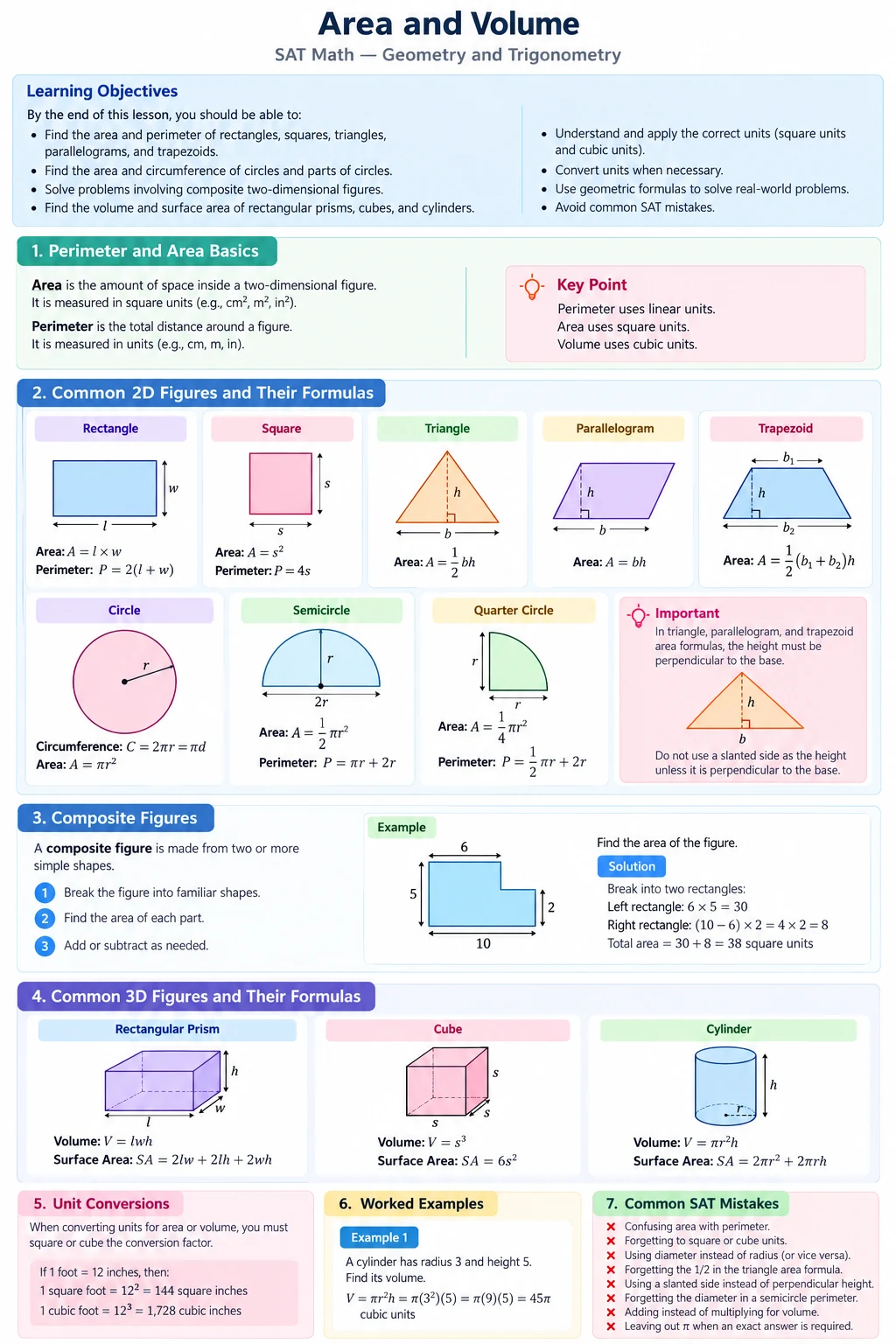
2. Rectangles and Squares
Rectangles
A rectangle has four right angles and opposite sides of equal length.
Area:
A = lw
Perimeter:
P = 2(l + w)
Where l is the length and w is the width.
Example
A rectangular garden is 14 meters long and 9 meters wide.
Area = 14 × 9
Area = 126 m²
Perimeter = 2(14 + 9)
Perimeter = 46 m
Squares
A square has four equal sides and four right angles.
Area:
A = s²
Perimeter:
P = 4s
Example
A square has area 81 cm².
81 = s²
s = 9 cm
Therefore:
Perimeter = 4(9) = 36 cm
Important: If the area of a square is given, take the positive square root to find its side length.
3. Triangles
The area of a triangle is:
A = ½bh
Where:
b = base
h = perpendicular height
The height must form a 90° angle with the base or the line containing the base.
Example
A triangle has base 16 cm and perpendicular height 7 cm.
A = ½(16)(7)
A = 56 cm²
Finding an Unknown Height
A triangle has area 45 square units and base 10 units.
45 = ½(10)h
45 = 5h
h = 9
Answer: 9 units
SAT Trap
Do not automatically use a slanted side as the height.
The height must be perpendicular to the chosen base.
4. Parallelograms and Trapezoids
Parallelogram
Area:
A = bh
Where h is the perpendicular distance between the parallel sides.
Example
Base = 12
Height = 5
Area = 12 × 5 = 60 square units
The slanted side is not normally used to calculate the area.
Trapezoid
A trapezoid has a pair of parallel sides called bases.
Area:
A = ½(b₁ + b₂)h
Where:
b₁ = first base
b₂ = second base
h = perpendicular distance between the bases
Example
A trapezoid has bases 8 and 14 and height 6.
A = ½(8 + 14)(6)
A = ½(22)(6)
A = 66 square units
5. Circles
A circle consists of points at the same distance from its center.
Radius (r): Distance from the center to the circle.
Diameter (d): Distance across the circle through its center.
d = 2r
r = d/2
Circumference
Circumference is the distance around a circle.
C = 2πr
Or:
C = πd
Example
A circle has diameter 18 cm.
C = π(18)
C = 18π cm
Area
A = πr²
Example
A circle has radius 6.
A = π(6²)
A = 36π square units
Important SAT Distinction
If the diameter is 10, the radius is 5.
Area = π(5²) = 25π
Do not calculate π(10²), because 10 is the diameter, not the radius.
6. Semicircles and Quarter Circles
A semicircle is half of a circle.
Area of a semicircle:
A = ½πr²
Perimeter of a semicircle:
P = πr + 2r
The perimeter includes the curved edge and the straight diameter.
Example
A semicircle has radius 4.
Area = ½π(4²)
Area = 8π
Curved edge = π(4) = 4π
Straight diameter = 8
Perimeter = 4π + 8
A quarter circle is one-fourth of a circle.
Area of a quarter circle:
A = ¼πr²
Perimeter of a quarter circle:
P = ½πr + 2r
7. Composite Figures
A composite figure is formed by combining or removing simpler shapes.
The main strategy is to break the figure into shapes with familiar formulas.
Example — Rectangle With a Semicircle
A rectangle measures 12 units by 8 units.
A semicircle is attached along one 8-unit side, which becomes the semicircle's diameter.
Step 1: Find the rectangle's area.
A = 12 × 8 = 96
Step 2: Find the semicircle's radius.
Diameter = 8
Radius = 4
Step 3: Find the semicircle's area.
A = ½π(4²)
A = 8π
Step 4: Add the areas.
Total area = 96 + 8π square units
Example — Area Removed From a Figure
A square has side length 10.
A circle of radius 5 is inside the square and touches all four sides.
Square area = 10² = 100
Circle area = π(5²) = 25π
Area inside the square but outside the circle = 100 − 25π
SAT Tip: In composite figures, identify whether areas should be added or subtracted.
8. Volume of Rectangular Prisms
A rectangular prism is a three-dimensional solid with rectangular faces.
Volume:
V = lwh
Where:
l = length
w = width
h = height
Example
A rectangular container measures 8 cm by 5 cm by 6 cm.
V = 8 × 5 × 6
V = 240 cm³
Finding a Missing Dimension
A rectangular prism has volume 360 cm³, length 12 cm, and width 5 cm.
360 = 12 × 5 × h
360 = 60h
h = 6 cm
9. Cubes
A cube has six equal square faces.
Volume:
V = s³
Surface area:
SA = 6s²
Example
A cube has side length 5 cm.
Volume = 5³ = 125 cm³
Surface area = 6(5²)
Surface area = 150 cm²
Notice that surface area is measured in square units, while volume is measured in cubic units.
10. Cylinders
A cylinder has two congruent circular bases joined by a curved surface.
Volume:
V = πr²h
Where r is the radius and h is the perpendicular height.
Example
A cylinder has radius 3 cm and height 8 cm.
V = π(3²)(8)
V = π(9)(8)
V = 72π cm³
Finding the Radius
A cylinder has volume 200π cubic units and height 8 units.
200π = πr²(8)
200 = 8r²
25 = r²
r = 5 units
The radius is positive because it represents a length.
11. Surface Area
Surface area is the sum of the areas of the exterior faces of a solid.
Rectangular Prism
SA = 2lw + 2lh + 2wh
Example
A box has dimensions 3, 4, and 5.
SA = 2(3×4) + 2(3×5) + 2(4×5)
SA = 24 + 30 + 40
SA = 94 square units
Cylinder
For a closed cylinder:
SA = 2πr² + 2πrh
The term 2πr² represents the two circular bases.
The term 2πrh represents the curved lateral surface.
Example
A closed cylinder has radius 3 and height 5.
SA = 2π(3²) + 2π(3)(5)
SA = 18π + 30π
SA = 48π square units
If a cylinder has no top, exclude the area of the missing circular face.
12. Scaling in Geometry
SAT problems may ask how changing the dimensions of a figure affects area or volume.
If every linear dimension is multiplied by a scale factor k:
Lengths multiply by k.
Areas multiply by k².
Volumes multiply by k³.
Example — Doubling Dimensions
A cube has side length 3.
Original volume = 3³ = 27
Its side length is doubled to 6.
New volume = 6³ = 216
Volume factor = 216/27 = 8
Therefore, doubling every dimension multiplies volume by 8.
Example — Tripling a Circle's Radius
Original area = πr²
New area = π(3r)²
New area = 9πr²
Therefore, tripling the radius multiplies the circle's area by 9.
SAT Tip: A twofold increase in length does not mean a twofold increase in area or volume.
13. Geometry Unit Conversions
Always distinguish between linear, square, and cubic units.
If:
1 foot = 12 inches
Then:
1 square foot = 144 square inches
1 cubic foot = 1,728 cubic inches
Example
A rectangular box has volume 864 cubic inches.
Find its volume in cubic feet.
Volume = 864/1,728
Volume = 0.5 cubic feet
Common Trap
Do not divide cubic inches by 12 to convert to cubic feet.
Divide by 12³ = 1,728.
14. Important SAT Formulas
Figure | Formula |
|---|---|
Rectangle area | A = lw |
Square area | A = s² |
Triangle area | A = ½bh |
Parallelogram area | A = bh |
Trapezoid area | A = ½(b₁ + b₂)h |
Circle area | A = πr² |
Circle circumference | C = 2πr |
Rectangular prism volume | V = lwh |
Cube volume | V = s³ |
Cylinder volume | V = πr²h |
Cube surface area | SA = 6s² |
Rectangular prism surface area | SA = 2lw + 2lh + 2wh |
Closed cylinder surface area | SA = 2πr² + 2πrh |
The SAT Math reference sheet provides several common geometry formulas. Nevertheless, you should understand when and how to use them rather than relying only on memorization.
15. Worked SAT-Style Examples
Example 1 — Finding a Missing Dimension
Problem: A rectangle has area 96 square centimeters. Its length is 12 centimeters. What is its width?
Solution:
A = lw
96 = 12w
w = 96/12
Answer: 8 cm
Example 2 — Triangle Area
Problem: The area of a triangle is 75 square units. The base is 15 units. Find the perpendicular height.
Solution:
75 = ½(15)h
150 = 15h
Answer: 10 units
Example 3 — Circle Area
Problem: A circle has circumference 16π. What is its area?
Solution:
C = 2πr
16π = 2πr
r = 8
Area = π(8²)
Answer: 64π square units
Example 4 — Composite Figure
Problem: A 14-by-10 rectangle has a 4-by-3 rectangle removed from one corner. Find the remaining area.
Solution:
Original rectangle area = 14 × 10 = 140
Removed rectangle area = 4 × 3 = 12
Remaining area = 140 − 12
Answer: 128 square units
Example 5 — Cylinder Volume
Problem: A cylinder has volume 180π cubic units and radius 6 units. Find its height.
Solution:
V = πr²h
180π = π(6²)h
180 = 36h
Answer: 5 units
Example 6 — Scaling
Problem: The side lengths of a square are increased by a factor of 3. By what factor does its area increase?
Solution:
Area scale factor = 3²
Answer: 9
Example 7 — Cubic Unit Conversion
Problem: A container has volume 3,456 cubic inches. What is its volume in cubic feet?
Solution:
1 cubic foot = 1,728 cubic inches
Volume = 3,456 / 1,728
Answer: 2 cubic feet
16. Common SAT Mistakes
Confusing perimeter, area, surface area, and volume.
Using the diameter instead of the radius in the circle area formula.
Forgetting the factor of ½ for triangles.
Using a slanted side instead of the perpendicular height.
Forgetting to add the straight diameter when finding a semicircle's perimeter.
Adding areas that should be subtracted in composite figures.
Treating a cube's surface area as its volume.
Forgetting the circular bases when finding the surface area of a closed cylinder.
Using incorrect units for area or volume.
Applying a linear scale factor directly to area or volume.
Forgetting to square or cube the unit conversion factor.
Using the wrong dimensions when solving a real-world geometry problem.
Rounding an answer involving π unnecessarily when an exact answer is requested.
17. Final Revision Checklist
Before completing this topic, make sure you can:
Distinguish area, perimeter, surface area, and volume.
Calculate areas of common 2D figures.
Use circle area and circumference formulas correctly.
Solve problems with semicircles and composite figures.
Find missing dimensions using known areas or volumes.
Calculate volumes of rectangular prisms and cylinders.
Calculate basic surface areas.
Understand how scaling affects area and volume.
Convert between linear, square, and cubic units.
Interpret word problems and select the correct formula.
Final SAT Strategy: Start by identifying the figure and the quantity requested. Label every dimension and its unit, choose the appropriate formula, and check that the final unit matches the question.