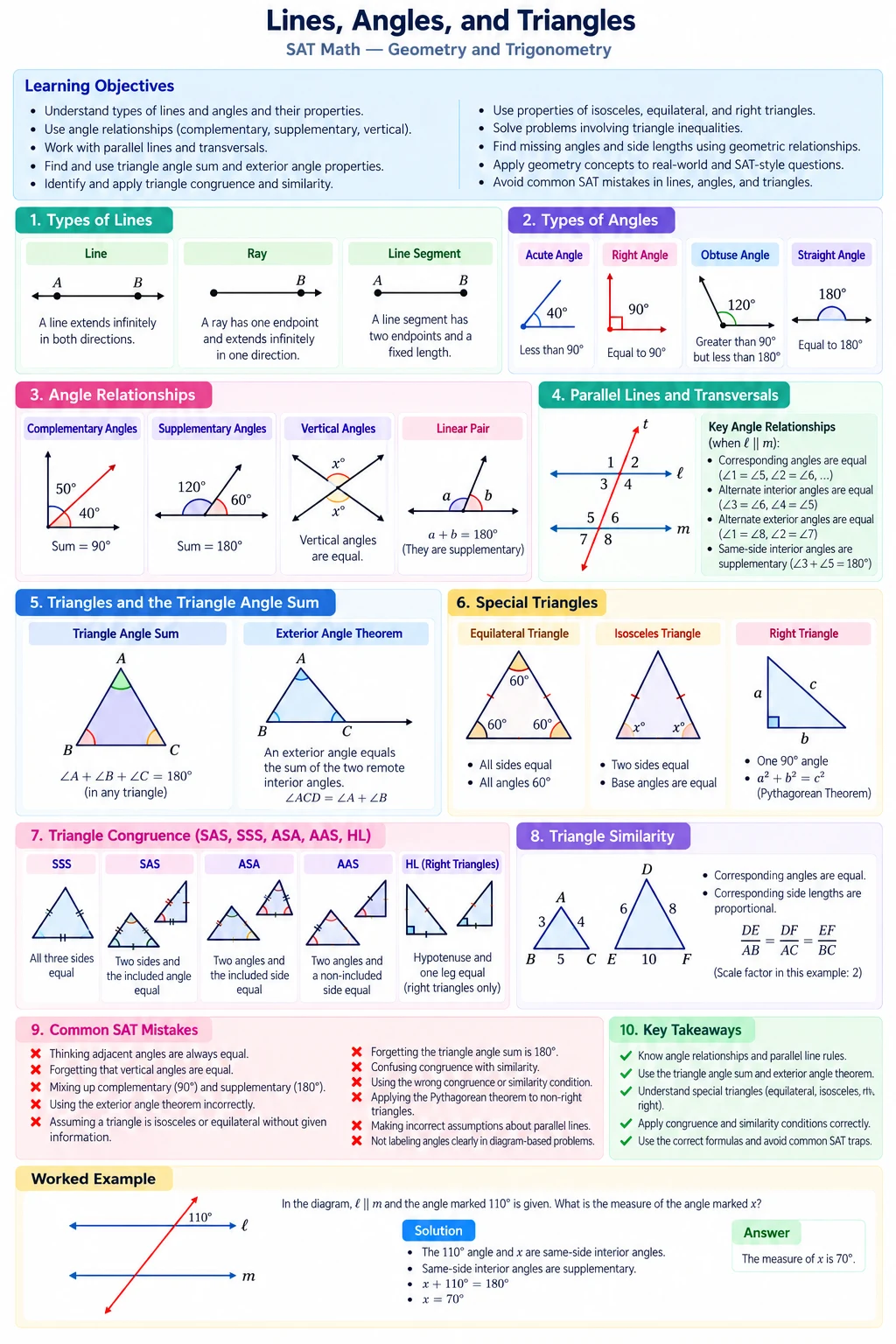
Lines, Angles, and Triangles
Find unknown angles, apply parallel-line rules, and solve similar-triangle problems using proportions and algebra. Includes worked SAT examples.
Lines, Angles, and Triangles
SAT Math — Geometry and Trigonometry
Learning Objectives
By the end of this lesson, you should be able to:
Identify acute, right, obtuse, and straight angles.
Calculate complementary and supplementary angles.
Find unknown angles using vertical angles and linear pairs.
Apply rules for parallel lines and transversals.
Use the triangle angle-sum theorem.
Apply the exterior angle theorem.
Recognize equilateral, isosceles, and right triangles.
Determine whether triangles are similar or congruent.
Use corresponding sides to solve proportions.
Apply the triangle inequality theorem.
Solve multi-step SAT geometry questions using algebra.
1. Understanding Lines and Angles
A line extends infinitely in both directions.
A line segment has two endpoints and a fixed length.
A ray begins at one endpoint and extends infinitely in one direction.
An angle is formed by two rays sharing a common endpoint called the vertex.
Angles are measured in degrees.
Types of Angles
Type | Measure |
|---|---|
Acute | Greater than 0° and less than 90° |
Right | Exactly 90° |
Obtuse | Greater than 90° and less than 180° |
Straight | Exactly 180° |
Full rotation | 360° |
Example
An angle measures 125°.
Since 125° is greater than 90° but less than 180°, it is an obtuse angle.
2. Complementary Angles
Two angles are complementary if their measures add to 90°.
a + b = 90°
Worked Example
One angle measures 34°. Find its complement.
a + 34° = 90°
a = 90° − 34°
a = 56°
Two complementary angles do not need to be physically adjacent.
3. Supplementary Angles
Two angles are supplementary if their measures add to 180°.
a + b = 180°
Worked Example
Two supplementary angles measure (3x + 10)° and (2x + 20)°.
Find x.
Step 1: Write the equation.
3x + 10 + 2x + 20 = 180
Step 2: Combine like terms.
5x + 30 = 180
Step 3: Subtract 30.
5x = 150
Step 4: Divide by 5.
x = 30
4. Vertical Angles
When two straight lines intersect, they form four angles.
The opposite angles are called vertical angles.
Vertical angles are equal.
Example
Two vertical angles have measures:
(4x + 10)°
(6x − 20)°
Since they are vertical angles:
4x + 10 = 6x − 20
30 = 2x
x = 15
The angle measure is:
4(15) + 10 = 70°
5. Linear Pairs
A linear pair consists of two adjacent angles whose noncommon sides form a straight line.
The angles in a linear pair are supplementary.
a + b = 180°
Example
One angle measures 118°.
The adjacent angle forming a linear pair is:
180° − 118° = 62°
Answer: 62°
SAT Tip: Vertical angles are equal. Adjacent angles forming a straight line add to 180°. Do not confuse these relationships.
6. Angles Around a Point
Angles around a point add to 360°.
Example
Three angles around a point measure 85°, 120°, and x°.
85 + 120 + x = 360
205 + x = 360
x = 155°
This rule is useful in diagrams containing multiple rays meeting at one point.
7. Parallel Lines and Transversals
A transversal is a line that intersects two or more other lines.
When a transversal crosses two parallel lines, predictable angle relationships occur.
Corresponding Angles
Corresponding angles occupy the same relative positions at the two intersections.
Corresponding angles are equal when the lines are parallel.
Alternate Interior Angles
Alternate interior angles lie between the parallel lines on opposite sides of the transversal.
Alternate interior angles are equal.
Alternate Exterior Angles
Alternate exterior angles lie outside the parallel lines on opposite sides of the transversal.
Alternate exterior angles are equal.
Same-Side Interior Angles
Same-side interior angles lie between the parallel lines on the same side of the transversal.
Their measures add to 180°.
Worked Example
Two parallel lines are cut by a transversal.
A pair of corresponding angles measures:
(5x + 15)° and (8x − 30)°.
Because corresponding angles are equal:
5x + 15 = 8x − 30
45 = 3x
x = 15
Substitute:
5(15) + 15 = 90°
Both angles measure 90°.
Important: These angle rules depend on the lines being parallel. Do not assume two lines are parallel merely because they appear parallel in a drawing.
8. Triangle Angle-Sum Theorem
The three interior angles of every triangle add to 180°.
A + B + C = 180°
Worked Example
A triangle has angles of 45°, 65°, and x°.
45 + 65 + x = 180
110 + x = 180
x = 70°
Algebraic Example
A triangle has angle measures:
2x°
3x°
4x°
Find x.
2x + 3x + 4x = 180
9x = 180
x = 20
Therefore, the angles are 40°, 60°, and 80°.
9. Exterior Angle Theorem
An exterior angle is formed when a side of a triangle is extended beyond a vertex.
The exterior angle equals the sum of the two nonadjacent interior angles.
Exterior angle = Remote interior angle 1 + Remote interior angle 2
Worked Example
Two remote interior angles are 48° and 67°.
The exterior angle is:
48 + 67 = 115°
Answer: 115°
Alternatively, the exterior angle and its adjacent interior angle form a linear pair and add to 180°.
10. Equilateral Triangles
An equilateral triangle has three equal sides.
All three interior angles are equal.
Since triangle angles total 180°:
180° / 3 = 60°
Every interior angle of an equilateral triangle is 60°.
Example
An equilateral triangle has perimeter 36 cm.
Each side is:
36 / 3 = 12 cm
Answer: 12 cm
11. Isosceles Triangles
An isosceles triangle has at least two equal sides.
The angles opposite those equal sides are equal.
These are called the base angles.
Worked Example
An isosceles triangle has a vertex angle of 40°.
The two base angles are equal.
Total base-angle measure:
180° − 40° = 140°
Each base angle:
140° / 2 = 70°
Answer: 70° each
SAT Trap
The fact that two sides look equal in a diagram is not enough. Their equality must be stated or indicated by markings.
12. Right Triangles
A right triangle contains exactly one 90° angle.
The remaining two angles add to 90°.
For side lengths:
a = one leg
b = other leg
c = hypotenuse
The Pythagorean theorem states:
a² + b² = c²
Worked Example
A right triangle has legs of lengths 6 and 8.
Find the hypotenuse.
6² + 8² = c²
36 + 64 = c²
100 = c²
c = 10
Common Pythagorean Triples
3, 4, 5
5, 12, 13
8, 15, 17
7, 24, 25
Multiples of these triples also form right triangles.
For example:
6, 8, 10 is twice 3, 4, 5.
13. Triangle Inequality Theorem
The sum of the lengths of any two sides of a nondegenerate triangle must be greater than the third side.
For side lengths a, b, and c:
a + b > c
a + c > b
b + c > a
Worked Example
Two side lengths are 7 and 12.
If the third side is x:
12 − 7 < x < 12 + 7
5 < x < 19
If x must be an integer, the possible lengths are 6 through 18.
SAT Tip: The inequalities are strict. Side lengths equal to the sum or difference of the other two do not form a proper triangle.
14. Congruent Triangles
Congruent triangles have exactly the same shape and size.
Their corresponding angles and sides are equal.
Common congruence conditions include:
SSS: All three corresponding sides are equal.
SAS: Two corresponding sides and the included angle are equal.
ASA: Two corresponding angles and the included side are equal.
AAS: Two corresponding angles and a corresponding nonincluded side are equal.
HL: In right triangles, the hypotenuse and one corresponding leg are equal.
Important: AAA establishes similarity, not necessarily congruence. SSA does not generally establish triangle congruence.
15. Similar Triangles
Similar triangles have the same shape, but they may have different sizes.
Corresponding angles are equal.
Corresponding side lengths are proportional.
Similarity Conditions
AA: Two pairs of corresponding angles are equal.
SSS Similarity: Corresponding side lengths are proportional.
SAS Similarity: Two pairs of corresponding sides are proportional and the included angles are equal.
Worked Example
Two similar triangles have corresponding side lengths:
Small triangle: 4, 6, 8
Large triangle: 10, 15, x
Scale factor:
10 / 4 = 2.5
Check:
15 / 6 = 2.5
Therefore:
x = 8(2.5)
x = 20
16. Scale Factors in Similar Triangles
If two triangles are similar with a side-length scale factor of k:
Corresponding side lengths multiply by k.
Perimeters multiply by k.
Areas multiply by k².
Example
The corresponding sides of two similar triangles have a ratio of 2:5.
The ratio of their areas is:
2² : 5²
Area ratio = 4:25
This type of relationship is useful in multi-step SAT geometry questions.
17. Parallel Lines Inside Triangles
Suppose a line segment connects two sides of a triangle and is parallel to the triangle's third side.
The smaller triangle formed at the top is similar to the original triangle.
Worked Example
A smaller triangle has a corresponding side of 6.
The larger triangle has the matching side of 15.
Another corresponding side of the smaller triangle is 8.
Find the matching side x of the larger triangle.
6 / 15 = 8 / x
6x = 120
x = 20
18. Solving SAT Geometry Questions With Algebra
SAT problems frequently describe angle measures using expressions containing variables.
Example
Two vertical angles measure:
(7x − 10)°
(5x + 18)°
Since vertical angles are equal:
7x − 10 = 5x + 18
2x = 28
x = 14
Angle measure:
7(14) − 10 = 88°
Answer: 88°
Always check whether the question asks for x or the angle measure. They may be different.
19. Worked SAT-Style Examples
Example 1 — Supplementary Angles
Problem: Two angles form a straight line. Their measures are (4x + 12)° and (2x + 18)°. Find x.
Solution:
4x + 12 + 2x + 18 = 180
6x + 30 = 180
6x = 150
x = 25
Example 2 — Parallel Lines
Problem: Two alternate interior angles formed by parallel lines measure (3x + 20)° and (5x − 10)°. Find x.
Solution:
3x + 20 = 5x − 10
30 = 2x
x = 15
Example 3 — Triangle Angles
Problem: A triangle has interior angles of (x + 15)°, (2x + 5)°, and (3x + 10)°. Find x.
Solution:
x + 15 + 2x + 5 + 3x + 10 = 180
6x + 30 = 180
6x = 150
x = 25
Example 4 — Isosceles Triangle
Problem: An isosceles triangle has a vertex angle of 36°. Find each base angle.
Solution:
180 − 36 = 144
144 / 2 = 72
Answer: 72°
Example 5 — Exterior Angle
Problem: The remote interior angles of a triangle are 38° and 74°. Find the exterior angle.
Solution:
38 + 74 = 112
Answer: 112°
Example 6 — Triangle Similarity
Problem: Two similar triangles have corresponding sides of 6 and 15. If another side of the smaller triangle is 8, find the corresponding side of the larger triangle.
Solution:
Scale factor = 15/6 = 2.5
Larger side = 8(2.5)
Answer: 20
Example 7 — Triangle Inequality
Problem: A triangle has side lengths of 8, 13, and x. If x is an integer, what is the greatest possible value of x?
Solution:
x < 8 + 13
x < 21
The greatest integer less than 21 is 20.
Answer: 20
Example 8 — Area of Similar Triangles
Problem: The corresponding side lengths of two similar triangles are in the ratio 3:7. If the smaller triangle has area 45, find the area of the larger triangle.
Solution:
Area scale factor = (7/3)² = 49/9
Larger area = 45 × 49/9
Larger area = 5 × 49
Answer: 245 square units
20. Common SAT Mistakes
Assuming adjacent angles are equal.
Confusing complementary and supplementary angles.
Forgetting that vertical angles are equal.
Applying parallel-line angle rules when parallelism is not established.
Confusing alternate interior angles with same-side interior angles.
Forgetting that triangle interior angles total 180°.
Using the exterior angle theorem incorrectly.
Assuming a triangle is isosceles merely because of its appearance.
Confusing congruence with similarity.
Using mismatched corresponding sides in a proportion.
Forgetting to square the scale factor when comparing areas.
Using the Pythagorean theorem for a triangle not known to be right.
Ignoring the strict inequalities in the triangle inequality theorem.
Finding the value of x when the question asks for an angle measure.
21. Final SAT Revision Checklist
Before attempting the practice questions, confirm that you can:
Identify all common angle types.
Solve complementary and supplementary angle problems.
Apply vertical-angle relationships.
Use corresponding, alternate interior, and same-side interior angle relationships.
Solve triangle interior and exterior angle problems.
Recognize properties of equilateral and isosceles triangles.
Solve missing side lengths in right triangles.
Apply triangle inequality.
Identify congruent and similar triangles.
Use scale factors and proportions.
Solve angle equations involving algebraic expressions.
Final SAT Strategy: Identify the geometric relationship first, write the appropriate equation, solve carefully, and check whether the final answer should be a variable, an angle, or a side length.