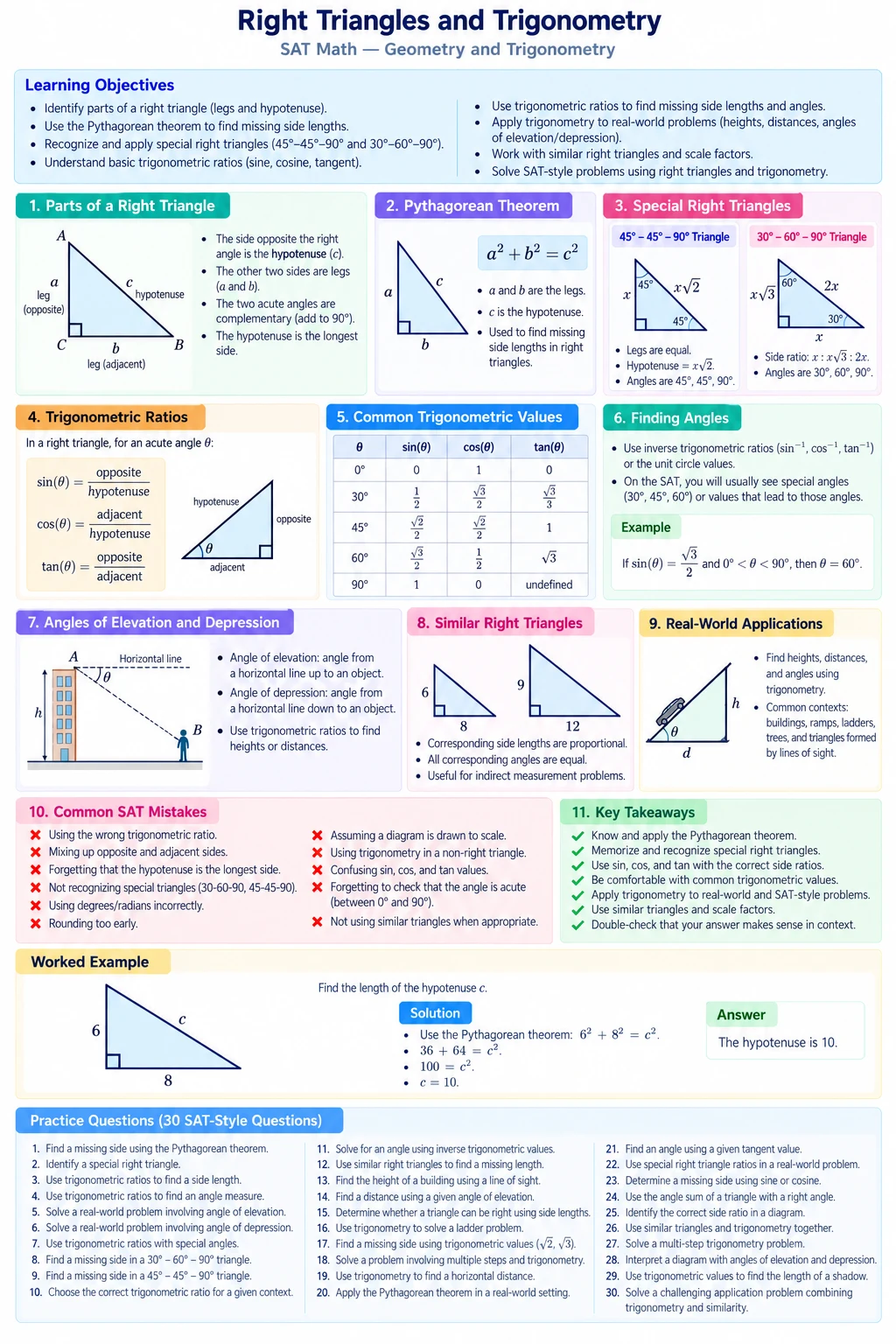
Right Triangles and Trigonometry
Use the Pythagorean theorem, special right triangles and sine, cosine and tangent to solve missing-side and angle problems for SAT Math.
Right Triangles and Trigonometry
SAT Math — Geometry and Trigonometry
Learning Objectives
By the end of this lesson, you should be able to:
Identify the legs and hypotenuse of a right triangle.
Apply the Pythagorean theorem to determine missing side lengths.
Recognize 45°–45°–90° and 30°–60°–90° triangles.
Use special right triangle ratios without unnecessary calculations.
Understand sine, cosine, and tangent.
Determine the correct trigonometric ratio for a given angle.
Find missing sides using trigonometric relationships.
Use known trigonometric values for 30°, 45°, and 60°.
Solve real-world problems involving heights, distances, and angles of elevation.
Apply similarity to right triangles.
Solve multi-step SAT geometry questions.
1. What Is a Right Triangle?
A right triangle is a triangle containing exactly one 90° angle.
The two sides forming the right angle are called the legs.
The side opposite the 90° angle is called the hypotenuse.
The hypotenuse is always the longest side of a right triangle.
If a right triangle has angles of 90°, 35°, and x°:
90 + 35 + x = 180
x = 55°
The two non-right angles must add to 90°.
Important: Do not assume a triangle is right-angled simply because its drawing appears to contain a right angle. Look for a right-angle marking or information establishing a 90° angle.
2. The Pythagorean Theorem
The Pythagorean theorem states that in a right triangle:
a² + b² = c²
Where:
a and b are the legs.
c is the hypotenuse.
This theorem can be used to find a missing side when two side lengths are known.
Example 1 — Finding the Hypotenuse
A right triangle has legs of lengths 9 and 12.
Step 1: Write the formula.
a² + b² = c²
Step 2: Substitute.
9² + 12² = c²
Step 3: Simplify.
81 + 144 = c²
225 = c²
Step 4: Take the positive square root.
c = 15
The hypotenuse is 15 units long.
Example 2 — Finding a Missing Leg
A right triangle has hypotenuse 13 and one leg of length 5.
Step 1: Write the equation.
5² + b² = 13²
Step 2: Simplify.
25 + b² = 169
Step 3: Subtract 25.
b² = 144
Step 4: Take the positive square root.
b = 12
Example 3 — Finding the Diagonal of a Rectangle
A rectangle is 8 units long and 6 units wide.
Find its diagonal.
The diagonal divides the rectangle into two right triangles.
8² + 6² = d²
64 + 36 = d²
100 = d²
d = 10
SAT Tip: When finding a missing leg, subtract the square of the known leg from the square of the hypotenuse. Do not add them.
3. Common Pythagorean Triples
Pythagorean triples are sets of three positive integers that satisfy:
a² + b² = c²
Common triples include:
First leg | Second leg | Hypotenuse |
|---|---|---|
3 | 4 | 5 |
5 | 12 | 13 |
8 | 15 | 17 |
7 | 24 | 25 |
Multiplying every side length of a Pythagorean triple by the same positive number produces another right triangle.
Examples:
3, 4, 5 multiplied by 2 gives 6, 8, 10.
5, 12, 13 multiplied by 3 gives 15, 36, 39.
Recognizing common triples can save time on SAT Math.
4. Special Right Triangles
Two particularly useful types of right triangles are:
45°–45°–90° triangles
30°–60°–90° triangles
Their side-length ratios are fixed.
45°–45°–90° Triangles
A 45°–45°–90° triangle is an isosceles right triangle.
Its legs are equal.
The ratio of the sides is:
1 : 1 : √2
If each leg is x, the hypotenuse is:
x√2
Example
A 45°–45°–90° triangle has each leg measuring 7.
The hypotenuse is:
7√2
Finding a Leg From the Hypotenuse
If the hypotenuse is 10√2:
Leg = 10√2 / √2
Leg = 10
Important Rule
In a 45°–45°–90° triangle:
Hypotenuse = leg × √2
Leg = hypotenuse / √2
5. 30°–60°–90° Triangles
A 30°–60°–90° triangle has side-length ratio:
1 : √3 : 2
The shortest side is opposite the 30° angle.
The longer leg is opposite the 60° angle.
The hypotenuse is opposite the 90° angle.
If the shortest side is x:
Side opposite 30° = x
Side opposite 60° = x√3
Hypotenuse = 2x
Example 1
The shortest side of a 30°–60°–90° triangle measures 5.
Find the hypotenuse.
Hypotenuse = 2 × 5
Hypotenuse = 10
The longer leg is 5√3.
Example 2
The hypotenuse measures 18.
Find the shortest side.
Shortest side = 18 / 2
Shortest side = 9
The longer leg is 9√3.
Example 3
The longer leg is 6√3.
Find the shortest side and hypotenuse.
x√3 = 6√3
x = 6
Hypotenuse = 2x = 12
Answer: Shortest side = 6; hypotenuse = 12
SAT Tip: Always identify which side lies opposite the 30° and 60° angles before using the ratio.
6. Introduction to Trigonometry
Trigonometry examines relationships between the angles and sides of triangles.
In a right triangle, three important ratios are:
Sine
Cosine
Tangent
These ratios use an acute reference angle, usually represented by θ (theta).
Relative to θ, the three sides are:
Opposite: The leg across from the reference angle.
Adjacent: The leg next to the reference angle that is not the hypotenuse.
Hypotenuse: The longest side, opposite the right angle.
The labels opposite and adjacent change when the reference angle changes.
The hypotenuse does not change.
7. The Three Trigonometric Ratios
Sine
sin(θ) = Opposite / Hypotenuse
Cosine
cos(θ) = Adjacent / Hypotenuse
Tangent
tan(θ) = Opposite / Adjacent
An easy memory aid is:
SOH — CAH — TOA
SOH: Sine = Opposite / Hypotenuse
CAH: Cosine = Adjacent / Hypotenuse
TOA: Tangent = Opposite / Adjacent
Example
A right triangle has:
Opposite side = 6
Adjacent side = 8
Hypotenuse = 10
For the reference angle θ:
sin(θ) = 6/10 = 3/5
cos(θ) = 8/10 = 4/5
tan(θ) = 6/8 = 3/4
All three ratios describe the same triangle relative to the chosen angle.
8. Choosing the Correct Trigonometric Ratio
The correct ratio depends on which sides are given and which side must be found.
Known or required sides | Useful ratio |
|---|---|
Opposite and hypotenuse | Sine |
Adjacent and hypotenuse | Cosine |
Opposite and adjacent | Tangent |
Example — Using Sine
A right triangle has an acute angle θ with:
sin(θ) = 3/5
The hypotenuse measures 20.
Find the opposite side.
sin(θ) = Opposite / Hypotenuse
3/5 = Opposite / 20
Opposite = 20 × 3/5
Opposite = 12
Example — Using Cosine
cos(θ) = 4/5
Hypotenuse = 25
Adjacent = 25 × 4/5
Adjacent = 20
Example — Using Tangent
tan(θ) = 3/4
Adjacent = 16
Opposite / 16 = 3/4
Opposite = 16 × 3/4
Opposite = 12
9. Important Trigonometric Values
For common special angles:
Angle | sin(θ) | cos(θ) | tan(θ) |
|---|---|---|---|
30° | 1/2 | √3/2 | √3/3 |
45° | √2/2 | √2/2 | 1 |
60° | √3/2 | 1/2 | √3 |
These values can be obtained from 30°–60°–90° and 45°–45°–90° triangles.
Example
Find the value of:
2sin(30°) + cos(60°)
Substitute:
2(1/2) + 1/2
= 1 + 1/2
Answer: 3/2
10. Complementary Angle Identities
The two acute angles in a right triangle add to 90°.
Therefore, sine and cosine have the following relationships:
sin(θ) = cos(90° − θ)
cos(θ) = sin(90° − θ)
Example
sin(35°) = cos(55°)
because:
35° + 55° = 90°
These relationships can help you solve questions without using a calculator.
11. Finding Missing Angles
When a trigonometric ratio is known, inverse trigonometric functions can be used to determine an angle.
For example:
sin(θ) = 0.5
For an acute angle:
θ = 30°
Another example:
tan(θ) = 1
For an acute angle:
θ = 45°
For non-special values, a calculator may be needed.
Set the calculator to degree mode when working with degree measurements.
12. Angles of Elevation
The angle of elevation is the angle measured upward from a horizontal line to an object.
Examples include looking from the ground toward:
The top of a building
The top of a tree
A flagpole
An elevated platform
These situations often form right triangles.
Worked Example
A person stands 30 meters horizontally from a building.
The angle of elevation to the top is 45°.
Find the building's height, assuming the angle is measured from ground level.
Use tangent:
tan(45°) = Height / 30
1 = Height / 30
Height = 30 meters
13. Angles of Depression
The angle of depression is measured downward from a horizontal line to an object below the observer.
For example, someone looking down from a building to a car on the ground measures an angle of depression.
If the horizontal lines are parallel, the angle of depression equals the corresponding angle of elevation.
This is because the two angles are alternate interior angles.
Example
An observer is 40 meters above level ground and sees a point on the ground at an angle of depression of 45°.
Let d be the horizontal distance.
tan(45°) = 40/d
1 = 40/d
d = 40 meters
14. Trigonometry in Real-World Situations
SAT questions can use right triangles to model:
Building heights
Ramp slopes
Ladder positions
Horizontal distances
Shadow lengths
Lines of sight
Roof measurements
Example — Ladder Against a Wall
A ladder is 13 feet long.
Its base is 5 feet from a vertical wall.
How high does the ladder reach?
The ladder is the hypotenuse.
h² + 5² = 13²
h² + 25 = 169
h² = 144
h = 12 feet
15. Similar Right Triangles
Two right triangles are similar if they have an equal acute angle.
Since both already have a 90° angle, the AA similarity condition is satisfied.
Corresponding sides of similar triangles are proportional.
Example
A smaller right triangle has legs of 6 and 8.
A larger similar triangle has the corresponding shorter leg of 15.
Find the longer corresponding leg.
Scale factor = 15/6 = 2.5
Larger leg = 8(2.5)
Answer: 20
16. Area of a Right Triangle
The two legs of a right triangle are perpendicular.
Therefore, they can serve as the base and height.
Area = ½ × leg₁ × leg₂
Example
A right triangle has legs of 9 and 12.
Area = ½(9)(12)
Area = 54 square units
The hypotenuse is not required to calculate this area.
17. Multistep SAT Questions
Sometimes the SAT combines the Pythagorean theorem with trigonometry.
Example
A right triangle has:
One leg = 8
Hypotenuse = 17
For an acute angle θ, the 8-unit leg is adjacent.
Find tan(θ).
Step 1: Find the missing opposite leg.
8² + b² = 17²
64 + b² = 289
b² = 225
b = 15
Step 2: Calculate tangent.
tan(θ) = Opposite / Adjacent
tan(θ) = 15/8
Answer: 15/8
18. Worked SAT-Style Examples
Example 1 — Missing Hypotenuse
Problem: A right triangle has legs measuring 12 and 16. Find the hypotenuse.
Solution:
c² = 12² + 16²
c² = 144 + 256
c² = 400
Answer: 20
Example 2 — 45°–45°–90° Triangle
Problem: A 45°–45°–90° triangle has hypotenuse 12√2. Find either leg.
Solution:
Leg = Hypotenuse / √2
Leg = 12√2 / √2
Answer: 12
Example 3 — 30°–60°–90° Triangle
Problem: The shortest leg of a 30°–60°–90° triangle is 8. Find its longer leg.
Solution:
Longer leg = x√3
Answer: 8√3
Example 4 — Sine Ratio
Problem: A right triangle has hypotenuse 25. Relative to angle θ, the opposite leg has length 7. Find sin(θ).
Solution:
sin(θ) = Opposite / Hypotenuse
sin(θ) = 7/25
Answer: 7/25
Example 5 — Cosine Ratio
Problem: A right triangle has adjacent side 12 and hypotenuse 13 relative to θ. Find cos(θ).
Solution:
cos(θ) = Adjacent / Hypotenuse
Answer: 12/13
Example 6 — Tangent Ratio
Problem: In a right triangle, the opposite and adjacent legs relative to θ have lengths 9 and 12. Find tan(θ).
Solution:
tan(θ) = 9/12
tan(θ) = 3/4
Answer: 3/4
Example 7 — Angle of Elevation
Problem: A point on the ground is 20 meters from a building. The angle of elevation to the roof is 45°. Find the building's height.
Solution:
tan(45°) = h/20
1 = h/20
Answer: 20 meters
Example 8 — Angle of Depression
Problem: A person stands on a platform 18 meters above level ground. The angle of depression to an object is 45°. Find the horizontal distance to the object.
Solution:
tan(45°) = 18/d
1 = 18/d
Answer: 18 meters
Example 9 — Similar Right Triangles
Problem: Two similar right triangles have corresponding legs in the ratio 3:5. The smaller hypotenuse is 12. Find the larger hypotenuse.
Solution:
Scale factor = 5/3
Larger hypotenuse = 12 × 5/3
Answer: 20
Example 10 — Right Triangle Area
Problem: A right triangle has legs of 10 and 14. Find its area.
Solution:
Area = ½(10)(14)
Answer: 70 square units
19. Common SAT Mistakes
Using the Pythagorean theorem on triangles that are not right triangles.
Treating a leg as the hypotenuse.
Adding side lengths instead of adding their squares.
Forgetting to take the positive square root.
Mixing up the ratios of 45°–45°–90° and 30°–60°–90° triangles.
Assuming all right triangles have equal legs.
Confusing the opposite and adjacent sides.
Using sine instead of cosine or tangent.
Forgetting that side labels depend on the chosen reference angle.
Treating an angle of elevation as measured from the vertical rather than the horizontal.
Confusing angles of depression with angles measured from a vertical wall.
Applying trigonometric ratios without identifying the right triangle.
Rounding intermediate calculations too early.
Forgetting units in contextual problems.
Reporting a decimal approximation when an exact radical answer is requested.
Using a wrong scale factor for similar right triangles.
Forgetting that the two acute angles of a right triangle add to 90°.
20. Final SAT Revision Checklist
Before moving to practice questions, make sure you can:
Identify the legs and hypotenuse.
Apply the Pythagorean theorem.
Recognize common Pythagorean triples.
Solve 45°–45°–90° triangles.
Solve 30°–60°–90° triangles.
Identify opposite and adjacent sides relative to an angle.
Apply sine, cosine, and tangent correctly.
Use common trigonometric values.
Find missing angles in right triangles.
Solve angles of elevation and depression.
Use similarity in right triangles.
Solve multistep trigonometry questions.
Final SAT Strategy: Draw or inspect the right triangle, label the reference angle, identify the known and unknown sides, and choose the simplest valid method. Use exact values when possible.